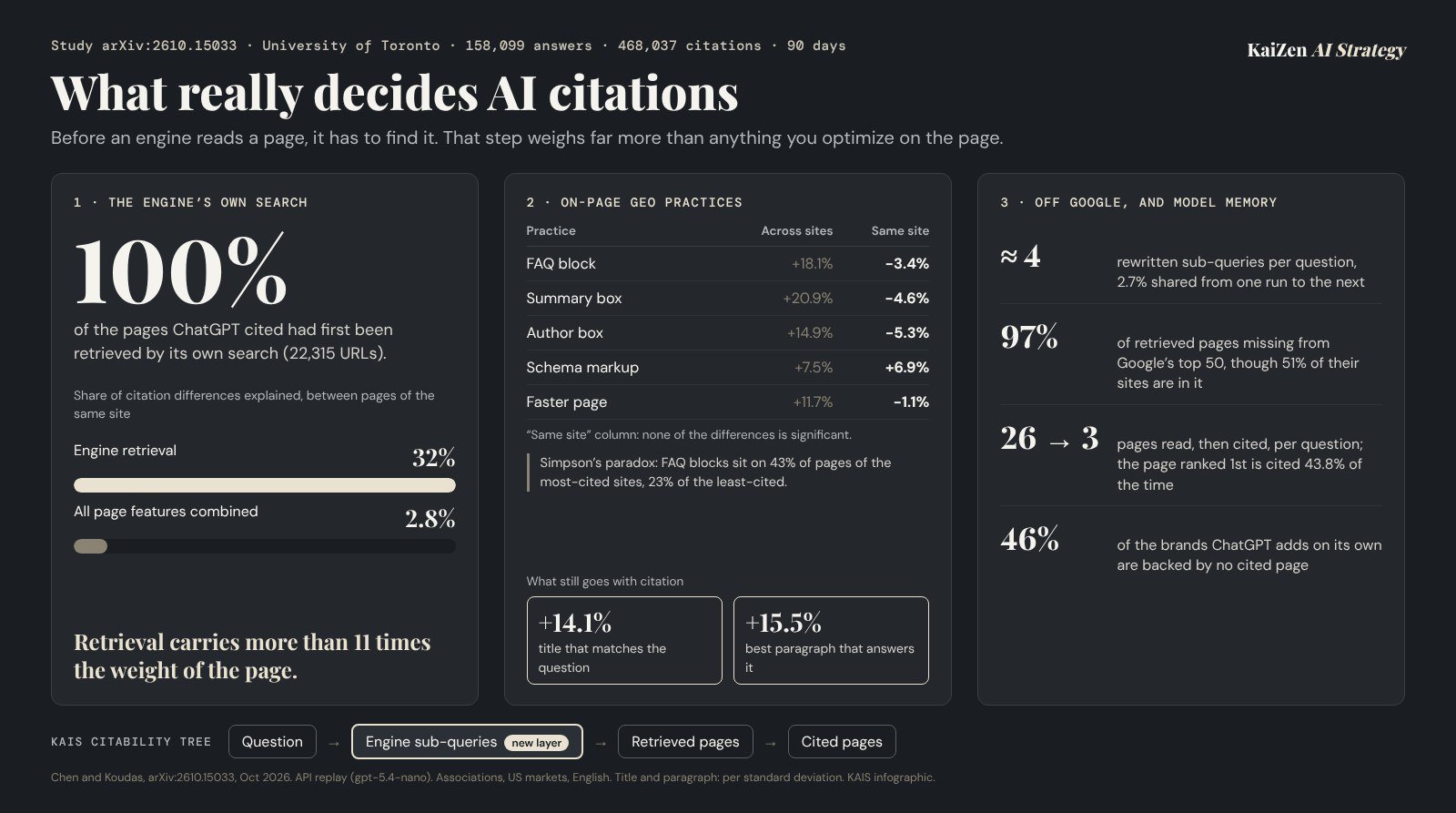
ChatGPT cites a page only if its own search retrieved it first, and that step weighs more than ten times as much as everything you optimize on the page. That is the central result of a study released on 10 October 2026 by Mahe Chen and Nick Koudas of the University of Toronto. Between pages of the same website, the search step explains 32% of the differences in citations. All page features combined, from FAQ blocks to schema markup to page speed, explain 2.8%.
The number behind everything else is blunt. The researchers replayed their questions through ChatGPT’s API with web search on, and logged, for every answer, the queries it sent and the list of pages it got back. Of 22,315 cited URLs, 100% were on that list. The engine cites nothing it has not searched for.
Most GEO work starts with the page: add an FAQ, add schema, add a summary box, add an author bio. This study moves the starting point. Before the page, there is a search the engine writes for itself, and nobody sees it. That is why KAIS is adding a layer to its citability tree.
What did the Toronto study measure?
The study arXiv:2610.15033 combines 90 days of answers, a replay of the engines’ searches and controlled experiments, across two very different markets. The first is US home internet, dominated by a few large brands: 651 questions, 143,249 answers, 396,188 citations. The second is a niche, proposal software for architecture and engineering firms: 55 questions, 14,850 answers, 71,849 citations. In total, 158,099 answers and 468,037 citations from ChatGPT, Gemini and Perplexity.
The design mostly compares pages of the same website with each other, and that choice is what makes the study useful. Comparing different websites mixes the effect of a practice with the effect of the site’s reputation. Comparing two pages of one site removes the second. The replay ran 13 times over 11 days up to 7 October 2026, using gpt-5.4-nano for ChatGPT and gemini-3.1-flash-lite for Gemini. Perplexity could not be replayed.
How does ChatGPT search before it answers?
ChatGPT rewrites each question into about four short, keyword-style queries, and it rewrites them differently on every answer. These sub-queries keep only 43% of the question’s words. 23% add the current year. 28% add a brand the user never named. Gemini tends to write three natural-language sub-questions that stay closer to the original.
The queries move a lot. Between two runs of the same question on the same day, ChatGPT’s queries overlap by only 2.7%, and its cited pages by 15%. They look like keywords, but the ranking follows meaning: a page’s position tracks its semantic closeness to the queries (correlation 0.20) more than word overlap (0.08).
For each question, ChatGPT consults 26 pages on average and cites 3. It takes them from the top of its own list. It cites 43.8% of the pages it ranks first, 35.5% of those ranked second, 12.2% of those at positions 6 to 10 and 3.5% of those at positions 11 to 20.
An engine sub-query is a query an answer engine writes itself from the user’s question, then sends to its search tool. In the study arXiv:2610.15033, ChatGPT writes about four per question, and every page it cites was first retrieved by one of them.
Is ranking first on Google enough?
No: 97% of the pages ChatGPT retrieves are missing from Google’s top 50 for its own queries, and 99% from Bing’s top 30. Gemini is grounded on Google Search, yet 93% of the pages it cites sit outside that same top 50. The public results were collected from a US location within one to two days of the replay, so neither place nor timing explains the gap.
The telling detail is elsewhere. 51% of the websites behind those pages do appear in Google’s top 50. The engines often pick the same sites as Google, but not the same pages. For a brand, the page Google ranks and the page ChatGPT retrieves may not be the same one. The gap between the two rankings is covered in First on Google, invisible in ChatGPT.
FAQ, schema, summary boxes: what still counts?
Between two pages of the same website, none of the most recommended GEO practices goes with more citations. The measured differences for ChatGPT: −3.4% for an FAQ block, +6.9% for schema markup, −4.6% for a summary box, −5.3% for an author box, −1.1% for a faster page. None is significant.
Across different websites, the same practices seem to work. There, an FAQ block goes with 18.1% more citations. The authors call it a case of Simpson’s paradox. FAQ blocks appear on 43% of the pages in the most-cited quarter of websites and on 23% in the least-cited quarter. The cross-site comparison credits the FAQ with what belongs to the website.
Two features pass all five of the study’s robustness tests. The first is a title that matches the questions people ask: +14.1% citations per standard deviation, +23.6% on third-party pages, +26.4% in the B2B market. The second is a paragraph that answers them: +15.5% for the page’s best paragraph, +25.7% on third-party pages. Both act through the same step. A page whose title and a paragraph match the engine’s queries in meaning rises in its list.
| Page feature | Difference in citations | Robust? |
|---|---|---|
| Best paragraph answers the question | +15.5% | Yes |
| Title matches the question | +14.1% | Yes |
| Schema markup | +6.9% | No |
| Faster page | −1.1% | No |
| FAQ block | −3.4% | No |
| Summary box | −4.6% | No |
| Author box | −5.3% | No |
Once pages are in the engine’s list, a few traits still shape the final pick at equal rank. Brand pages are cited more (×1.71), as are pages with more headings (×1.28) and shorter pages. Lists (×0.54), comparisons (×0.34) and Reddit threads (×0.30) are often consulted and rarely cited. FAQ blocks, schema and author boxes add nothing at this step either.
Where does the model’s memory come in?
The model writes brands it already knows into its searches, and it names some brands with no page to back them. When a brand is part of what the model associates with a question, ChatGPT adds it to its queries 67% of the time, against 11% otherwise. And 46% of the brands ChatGPT mentions without the question naming them are backed by no cited page.
The niche market shows the other side. The models barely know the small software vendors. ChatGPT almost never writes them into its queries (3% against 28%) and discovers them in a first round of results. A cited third-party page that names a vendor multiplies by 39.7 the odds that ChatGPT names it too, against 4.2 for the big brands. For a brand the models barely know, visibility runs through third-party pages that the engine’s search finds.
Do the results hold over time?
Poorly: what explains a site’s citations changes fast, and faster still on Perplexity. Within a two-week window, 63% to 67% of the differences between pages repeat. Two weeks later, the shared part drops to 40% for ChatGPT, 47% for Gemini and 22% for Perplexity. Ten weeks later, 14%, 29% and 0% remain.
The authors list their limits. Their results are associations, except for the controlled experiments on the answer step. Both markets are American and English-language. The replay runs on small API models, which are not the interface the public sees. Another study released the next day (arXiv:2610.15382) measures that gap: OpenAI’s API and Google combined recover only about a quarter of the URLs ChatGPT cites in its web interface, and about half of the websites.
Established: in the API replay, every page ChatGPT cited had been retrieved by its search, and that search explains far more of the differences between pages of one site than page features do. Not established: that the same proportions hold for ChatGPT’s public interface, outside the US or in languages other than English. Not tested: the effect of an intervention, such as rewriting a title and measuring citations before and after.
What does KAIS change in its method?
KAIS adds an “engine sub-queries” layer to its citability tree. Until now, the tree linked a buyer’s decision question to the secondary questions it raises, then to the sources that answer them. It now runs through the engine’s search: the question, the rewritten queries, the retrieved pages, the cited pages.
- Layer 1 · Decision question“Which firm should I hire to set up a company in Thailand?”
- Layer 2 · Engine sub-queries new layercompany setup firm Thailand 2026 Bangkok company registration fees Bangkok law firm reviews foreigners≈ 4 per question, rewritten on every answer
- Layer 3 · Retrieved pagesThe list the engine ranks itself, often outside Google’s top 50≈ 26 consulted per question
- Layer 4 · Cited pagesTaken from the top of that list≈ 3 per question
The audit log changes first. KAIS audits are run by hand, in the interfaces buyers actually see. When ChatGPT shows the searches it runs, the log now records them word for word. Whatever the interface does not show stays blank; we don’t guess it. Since the queries change from one answer to the next, we read what recurs across several runs, never a single query.
Diagnosis changes next. A page missing from an answer can fail in two places. Either the engine’s search doesn’t find it, and editing its content does nothing until its title and paragraphs match those queries. Or it is found but not picked, and what it contains, at equal rank, decides. The old tree could not tell the two apart. How to diagnose a specific page is covered in Why AI doesn’t cite your page.
Production changes last. One page, one question. A title that repeats the question the way buyers ask it. A first paragraph that answers it on its own. And for a brand the models barely know, third-party pages that name it on the right questions. One idea still needs checking, and it is a KAIS reading, not a finding of the study: since nearly one query in four adds the year, a page that carries a date kept up to date may match those queries better.
Four rules the study supports
- A title that asks the question: one of only two features linked to citation within a site.
- A paragraph that answers on its own: the page’s best paragraph weighs as much as its title.
- Third-party pages for lesser-known brands: ×39.7 in the niche market studied.
- No FAQ or schema for citation’s sake: they may help readers, but no effect shows up within a site.
Where does this sit in the KAIS AI Visibility Chain?
The study sits at the second stage of the KAIS AI Visibility Chain, Be Retrieved, and shows that Be Cited depends on it entirely.
Be Discovered → Be Retrieved → Be Understood → Be Trusted → Be Cited → Influence the Answer → Be Recommended.
It also touches Be Trusted, through the model’s memory. A website the model already associates with a question ranks higher in its list and has 1.60 times the odds of being cited at equal rank. Memory acts upstream of the search, by feeding it brand names, and downstream, by naming brands with no source.
The engine asks its own questions
For years, search optimization meant guessing a user’s words. Answer engines add a middleman. They read the question, write their own queries and cite only what those queries bring back.
A page can be well written, well marked up and fast, and never get cited, because none of those queries finds it. That was the layer the tree was missing.
Sources and references
- Chen and Koudas — What Drives AI Citations? Content, Retrieval and Model Knowledge in Generative Engine Optimization (GEO), arXiv:2610.15033 [cs.IR], 10 October 2026, University of Toronto. First version, not peer-reviewed. Data (section 3), page features within websites and Simpson’s paradox (section 4), stability over time (section 5), search replay, ranks and sub-queries (sections 6.1 to 6.3), share explained by retrieval (section 6.4), model knowledge (section 6.5), second market (section 7). Every figure in this article comes from the study; none was reproduced or remeasured by KAIS.
- Jiang, Zhang, Xing, Chang and Xiao — Understanding ChatGPT Citations: Evidence from Production Web Search Across Model Generations, arXiv:2610.15382 [cs.IR], 11 October 2026. The gap between OpenAI’s API, Google and ChatGPT’s web interface: 26% to 28% of cited URLs recovered.